Lacy baby shawl
Mothering SundayThe Lacy baby shawl is the surviving material clue to Sunday Small’s birth and the secret of her parentage. For years it lies unopened among the garments she wore when she was left at the workhouse; when Sunday finally examines it, its resemblance to other baby shawls associated with Lady Lavinia Huntley’s family prompts her to reconsider who she is. Its significance rests not on a written label or a spoken explanation, but on a pattern of matching clothes, remembered relationships and concealed history that the object allows Sunday to assemble.
Appearance and Provenance
The shawl is part of a small set of infant garments preserved in a brown-paper package tied with string. When Sunday opens it at Yew Tree Farm, she finds a tiny nightgown and a beautiful, lacy shawl that seems fit for a princess. The items appear unusually expensive to her, suggesting that the person who had dressed her as a newborn had access to money and fine goods. The old paper is brittle, a physical reminder that the parcel has remained untouched for years.
Sunday had been given the package when she left the workhouse, but had kept it closed. She understood that the small garments had been handled by the woman who gave birth to her, and opening them seemed to threaten the hope that her mother might one day return. The shawl therefore begins as more than an heirloom or a keepsake: it is an object Sunday both possesses and avoids, carrying a history she longs to know but fears will confirm her abandonment. When she eventually opens the parcel, she studies the garments and tries to imagine the woman who dressed her, but wraps them up again and puts them away without yet understanding their connection to her birth.
The clothes belong to the story of Lady Lavinia Huntley’s pregnancies. Lady Lavinia had ordered baby garments from an exclusive shop in London’s Mayfair before the birth of her first daughter, who was stillborn. The clothes were carefully stored; Sunday later recalls being told that items from this collection had not been worn, apart from being used to bury the tiny bodies. A second daughter was also stillborn. This history gives the shawl a provenance tied to repeated loss, while its survival in Sunday’s possession points toward a different outcome for another newborn girl.
Recognition at Yew Tree Farm
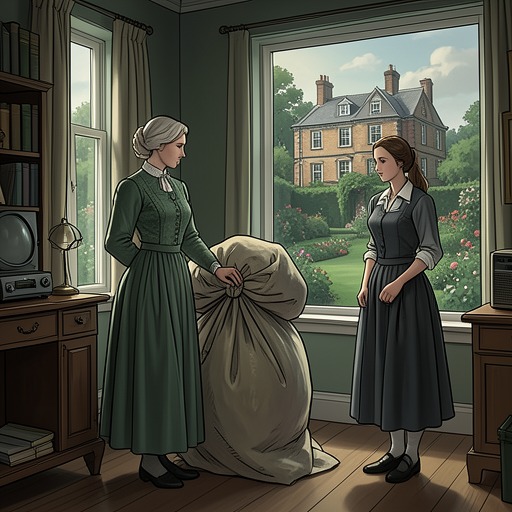
The shawl’s meaning changes when Sunday’s belongings are scattered during an accusation that she has stolen pearls. Among the items lies the baby shawl, and its familiarity suddenly becomes clear to her. The immediate trigger is visual recognition: she remembers that Verity Lockett’s baby had worn an identical shawl, and that Lady Lavinia had given it to Verity. She also recalls that Stephen Huntley had one like it. What had seemed an expensive but obscure possession now belongs to a recognizable group of baby clothes connected with Lady Lavinia.
The discovery sends Sunday back to her attic room, where she tries to fit the remembered details together. Lady Lavinia had told her about the garments ordered before the birth of her first daughter; Sunday knows that she herself was born on the same day of the week as the later daughter would have been, and that they would be the same age. The identical shawl makes these details feel less like coincidence and more like evidence. Sunday considers whether she was Lady Lavinia’s third daughter, abandoned because her father, Ashley Huntley, wanted a son to inherit from his late uncle. At this stage, however, the shawl prompts a hypothesis rather than certainty. Sunday cannot reconcile it with the graves at Treetops Manor, and cannot believe that the woman she has come to care for could knowingly abandon her child.
The accusation surrounding the pearls is separate from the shawl’s origin, but it precipitates this recognition by bringing the garment into view. Sunday’s attention shifts from the pearls and the threat made against her to the shawl itself. The object interrupts the immediate dispute and returns her to the unanswered question of her infancy: why a baby left at the workhouse steps possessed clothes that matched those supplied for Lady Lavinia’s children.
The Hidden History of the Child
Zillah’s later account confirms what Sunday had only been able to infer. On the night Lady Lavinia gave birth to a girl, Ashley Huntley ordered that the newborn be disposed of and threatened those present with silence. Zillah concealed the living baby in her room, while a pillow wrapped in a shawl was taken to the grave prepared for the child. The supposed burial thus hid the baby’s survival; later, Zillah carried her to the workhouse, left her on the steps and waited until someone came to take her in. She withheld the child’s identity even from Verity, though she expected to learn indirectly how the baby was faring.
Zillah identifies the surviving child as Sunday Small, Lady Lavinia’s daughter. Her confession establishes the family relationship that the matching garments had suggested, and explains how Sunday’s baby clothes came to be associated with Lady Lavinia’s household. The account also places the shawl within a wider pattern of concealment: the false grave gave the household an apparent ending, while Zillah’s actions preserved the child and carried her into another life. The evidence does not make the shawl itself a complete record of that rescue; rather, its resemblance to the other garments helps Sunday recognize the connection that Zillah eventually confirms.
Narrative Function and Meaning
The shawl changes from a private remnant of abandonment into a clue that can be interpreted. Its fine workmanship first tells Sunday only that her unknown mother may have been able to afford costly clothing. Its match with the shawl given to Verity’s baby, and with Stephen’s, supplies a more specific connection. Finally, Zillah’s disclosure turns that connection into knowledge: Sunday was not merely an abandoned infant whose past could never be recovered, but the daughter of the woman whose life had become closely entangled with hers.
The object also links two forms of maternal loss without making them identical. Lady Lavinia believed that her newborn daughter had died and visited what she thought was the child’s grave; Sunday grew up without knowing that the woman she had come to care for was her mother. The shawl belongs to the material world of Lady Lavinia’s lost children, but its presence with Sunday records the survival concealed beneath that apparent bereavement. The revelation eventually makes reconciliation possible, though the shawl is a clue rather than the means of their final meeting. On Mothering Sunday, Sunday offers Lady Lavinia violets and calls her Mother; the reunion rests on the truth the shawl helped her uncover, and on the relationship the two women have formed before knowing their blood tie.